Anna Thorwald’s concealed corpse
Rear WindowAnna Thorwald’s concealed corpse is the hidden fact at the center of Hal Jeffries’s investigation of Lars Thorwald. Its concealment in a newly laid floor above Lars’s apartment allows a search of the wrong flat to find nothing, while fragments of ordinary behavior and the building’s unfinished construction gradually disclose where Anna is hidden. The corpse is not discovered through a confession or a direct view of the crime, but through a delayed recognition of how the apartment’s altered floor level explains an otherwise puzzling visual detail.
Disappearance and Delayed Recognition
The suspicion begins with a break in habit. When Lars comes home wearing his hat, Anna does not appear to greet him, as Hal expects she ordinarily would. Hal watches Lars remain apart from the bedroom and considers an innocent explanation: Anna may be ill or asleep. But Lars does not go in to check on her. The absence of a familiar greeting becomes the first visible break in what Hal thinks of as the household’s chain of daily habits.
Other discrepancies accumulate around the packed trunk. Lars takes several drinks after it is sent away, although it had been packed and ready since the night before; he has also slept in the living room rather than in the bedroom. Hal lists these details against the possibility that Anna has simply been sent away for her health. That explanation accounts for some irregularities, but, in his reasoning, not Lars’s avoidance of a bedroom that should now be empty. The clues remain ambiguous: Hal has seen no attack and knows only that Anna has stopped appearing.
The suspicion becomes certainty for Hal when Lars finally enters the bedroom, raises the shade, looks around as if searching an empty room, and flips over the mattresses. Anna is not there. The action does not show Hal what happened to her, but it gives a landing place to the uneasiness he has been carrying for two days. He describes the recognition as delayed action: his instinctive suspicion has outrun his rational accounting, and the sight of the empty beds makes the thought of murder suddenly definite. He also checks that conclusion against its limits, reminding himself that absence is not, by itself, proof of what Lars has done.
The First Search and the Missed Location
The corpse’s location explains why the first police search fails. When Lars leaves, two men enter his apartment and search thoroughly, dividing their attention between the bedroom and kitchen before examining the living room together. They finish and depart when Lars is apparently returning. Hal is not surprised that they find nothing incriminating: the trunk has already gone, and Anna is concealed elsewhere. Their search is careful, but its boundary is the apartment they believe they need to search.
The other possible hiding place emerges from the building’s geography and construction. The fifth-floor apartment above Lars’s is still being worked on, while an apartment two floors above it has already been finished. During an accidental synchronization, Hal sees a renting agent and a prospective tenant move from living-room windows to kitchen windows as Lars makes the same passage below. At the second set of windows, the agent appears taller in relation to Lars than he did at the living-room windows. Hal first registers only a hitch in the parallel movement; later he identifies it as a vertical jump. The difference matters because floors are being raised in the apartments under renovation.
This clue shifts attention away from Lars’s searched rooms and toward the unfinished Rear Apartment on the Fifth Floor at 525 Benedict Avenue. The investigators had been looking for the body in the space Lars occupied, but the construction work provided another place to conceal it. Hal tells Inspector Boyne that the Cement Kitchen Floor in the Fifth-Floor Apartment has been raised above the level of its other rooms. He connects that unusual height to a floor laid during the renovation and identifies the space that must be opened.
Concealment and Its Reconstruction
After the floor clue comes together, Inspector Boyne goes to the unfinished apartment with the police. The electricity has not yet been connected, so the officers use torches. In about half an hour, Boyne signals Hal from the window to confirm that the search has succeeded. By the following morning, the dead have been removed. The body’s recovery confirms that the central suspicion was right and that the initial search of Lars’s apartment had not reached the place where Anna was hidden.
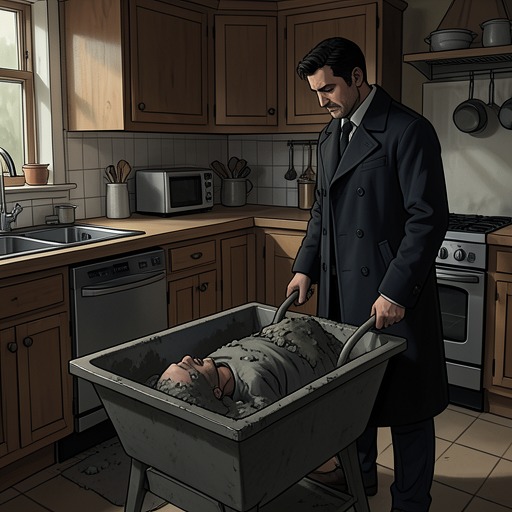
Hal’s account of how the concealment was carried out is more qualified than the discovery of the hiding place. He proposes that Lars had been trying to poison Anna slowly, perhaps in connection with insurance, and that she caught him during the night when the lights stayed on. In Hal’s reconstruction, Lars then killed her violently and improvised a hiding place in the newly laid floor above. He believes Lars made a trough in the still-soft cement, placed Anna’s body inside, and covered it with fresh cement, perhaps raising the floor to conceal it. These details are presented as Hal’s theory, not as events he witnessed or independently established in the account.
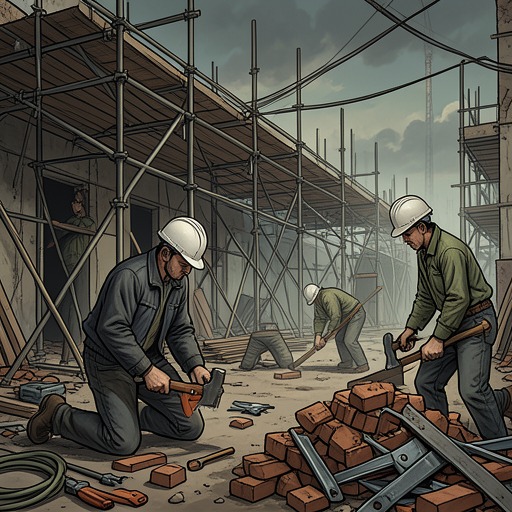
The surrounding construction made the hiding place plausible: the upper apartment had recently received its cement floor, and workmen later laid cork surfacing over it. Hal speculates that Lars used a workman’s trowel to smooth the surface. The apartment’s unfinished state thus offered both access to fresh material and a way to hide the disturbance beneath the planned flooring. The covering concealed the body within an ordinary renovation rather than removing it from the building.
The False Departure and the Body’s Significance
The concealment forms part of a larger false-departure scheme in Hal’s reconstruction. He believes Lars sent an accomplice upstate with the trunk keys, dispatched Anna’s trunk, and placed an already-used postcard in his mailbox with its year-date blurred. Hal supposes the plan was to make it appear that Anna had left and, later, died by suicide, with illness offered as an explanation. He further conjectures that Lars hoped this account would support an insurance claim. The supposed poison plot, the circumstances of Anna’s death, and the intended insurance fraud remain Hal’s theory; the recovered body and its hiding place are the facts that directly resolve the mystery of her disappearance.
The corpse also gives retrospective meaning to details that had seemed individually inconclusive: the empty bedroom, the missing greeting, the packed trunk, the long-lit apartment, and the raised floor. The narrative makes recognition itself part of the discovery. Hal’s eyes first register an unexplained difference in height; only later does his reasoning connect that difference to the unfinished apartment and the concealed body. Anna’s absence is therefore not merely the mystery that prompts the investigation. Once the body is found beneath the floor, it becomes the material link between disrupted household routines, a deceptive appearance of departure, and the building’s otherwise mundane renovation.